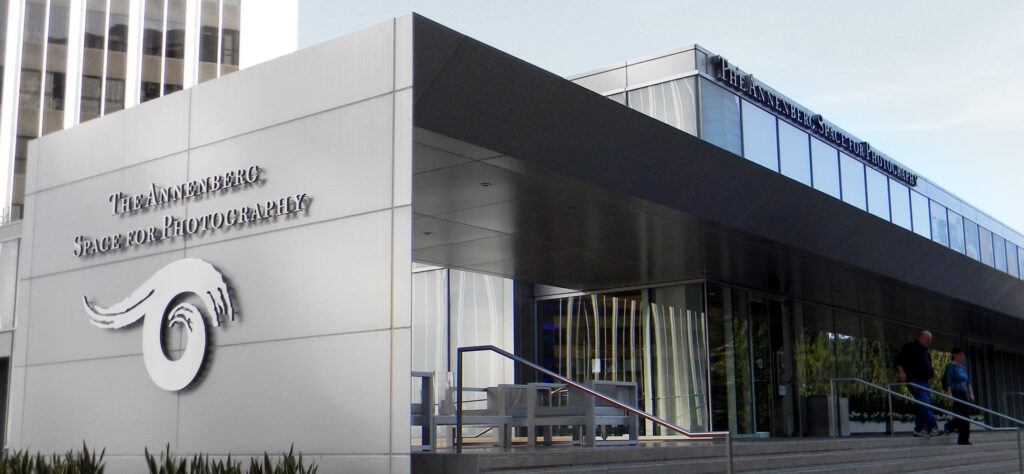
When The Annenberg Foundation began discussing plans for opening the Annenberg Space for Photography in Los Angeles, their goal was to create a world-class exhibition space for photography, a venue that would give photographers the best-possible platform for exhibiting and discussing their work.
Now a year old, The Annenberg Space has achieved that goal by combining a traditional print gallery with a cutting-edge digital exhibition system that has other art institutions taking notice.
As plans for the Space took form a few years ago, the foundation had a critical decision to make: They could listen to those who suggested that no world-class institution would exhibit work digitally, or they could use digital technology to create a singular experience for photographers and their audience. “One of the most important decisions that we made was to embrace the advent of digital technology at a time when it wasn’t en vogue to do it,” says Leonard Aube, Executive Director of The Annenberg Foundation.
The Space found a way to combine available hardware and software to create a custom digital gallery unlike any other in existence.
Images and motion content are displayed at 4K (4096◊2160) resolution on two 7′ x 14′ screens. Pictures from four separate projectors blend along X- and Y-axes to create a single image, and the servers used at the space allow the playback of uncompressed TIFF files at 60 frames per second. Exhibiting photographers are asked to provide files that are 5000 pixels on their longest edge. Arclight Productions, the company that creates the audiovisual content for the digital gallery and the 13 other HD screens at the Space, films all of their interviews using a RED One camera so image quality is consistently high.
“The key to making the photography look really good is the resolution for one—every frame we’ve produced, you could make a poster out of it,” says Arclight’s Steve Kochones. “There’s no compression, and playing at 60 frames per second, what that does is it gives you more information as a viewer to your eye. Also any kind of motion that we may do on pictures, it tracks really easily, it doesn’t look like we shot a TV show and blew it up onto a big screen.”
Until 3D began looking like the technology of the future for cinema, the movie business had been moving toward 4K, says Kochones. How the Annenberg Space for Photography came to possess this technology is partly due to chance. Foundation staff, including Leonard Aube, were visiting Christie Digital Systems, which manufactures projectors and other digital display solutions, when a Christie employee began talking about a new technology being worked on in the research and design department of the company. The foundation staff asked to see what the fuss was about. Up until that point the foundation believed the best display option available to them was through a media wall, a grid of HD plasma screens that would leave small gaps in the display of images. “What we saw fundamentally changed our thinking,” says Aube. “We were seeing high resolution images in a seamless environment, and yet we knew the technology backbone to achieve it was incredibly complicated and had never really been stitched together before.”
Aube says the Foundation was eager to use the display technology, but the Christie reaction was, “We’re not sure we can give you this because it doesn’t exist.” The Foundation said it was willing to wait.
With the help of consultants, the Foundation used Christie projectors, a Vista Spyder display processor also manufactured by Christie, and other hardware and software to create the custom projection system for the space.
When Kochones and Arclight got involved, the projection system was set, but the playback system and workflow for creating the audiovisual content was not. Kochones and his team had playback server “shootouts” and eventually settled on the Cine4K, which is manufactured by a Hamburg-based company, DVS.
The creative work on each presentation is done in Apple Final Cut Pro using jpegs that are 50 percent of the size of the final. Arclight then uses Adobe After Effects compositing software, and formulas they developed specifically for their work for The Annenberg Space, to translate the final HD program into 4K.
The Cine4K’s ability to play back uncompressed TIFF files at 60fps makes creating the presentations for each show time consuming because it requires rendering the 8 terabytes of data Arclight creates per show. However, one big advantage is that each of the 90,000 TIFF frames that make up a presentation can be dropped in or pulled out of the presentation, making it easy to correct any mistakes.
All of this translates into the only digital exhibition system for photography of its kind in the world. And Aube says the Annenberg Space has already identified ways to upgrade their system and will continue to stay on the cutting edge of exhibition technology.
“Having the photographers feel like their work is celebrated in a context that’s never been achieved before,” is a big part of the success of the Space, Aube says. “Photographers really enjoy having their work exhibited here.”
As a foundation that provides grants to other cultural institutions, the Annenberg Foundation has also used their digital gallery to show other organizations what might be possible for them.
“A good number of leaders of other institutions have been by and looked at this,” Aube says. “What you hear stated under their breath is, ‘Boy, we gotta get one of these.’ It’s a really compelling experience, and I think creating models of aspiration help advance the field. Regardless of what the discipline is, we feel the Annenberg Space for Photography is a model of aspiration.”